
How long do dental implants last? The titanium implant post itself can last 25 years or more, and often the rest of your life. The crown on top typically lasts 10 to 15 years before normal wear calls for a replacement. Success rates run above 95% at the ten-year mark. What you do after placement decides which end of those ranges you land on.
Christopher J. Manduzzi, DDS, PC serves dental implant patients across Utica, Shelby Township, Sterling Heights, Rochester Hills, and the greater Macomb County, Michigan area.
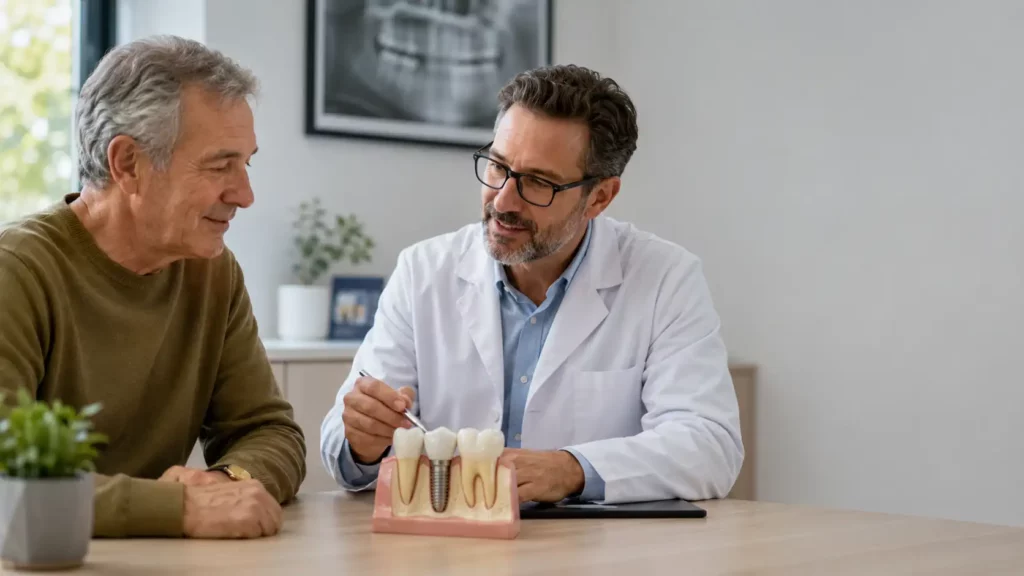
When patients ask us how long implants last, they’re rarely asking for a statistic. They’re asking a money question and a life question at the same time. You’re about to invest real money in a tooth. You want to know whether it will outlast the car, the roof, and ideally, whether it’s the last time you’ll ever deal with that spot in your mouth.
So here’s the honest version, the same one patients hear in our consultation room.
Our practice is led by Christopher J. Manduzzi, DDS, a Fellow of the International Congress of Oral Implantologists. We’ve been placing and restoring dental implants in downtown Utica for years, which means we’ve seen what implants look like 5, 10, and 20 years after placement. That long view is what this post is really about.
The Two-Part Answer Most Articles Bury
Short answer: An implant is two things with two different lifespans. The titanium post in your jawbone is built to last decades, often for life. The crown on top is a wear part that typically needs replacement every 10 to 15 years. Replacing a crown is maintenance, not failure.
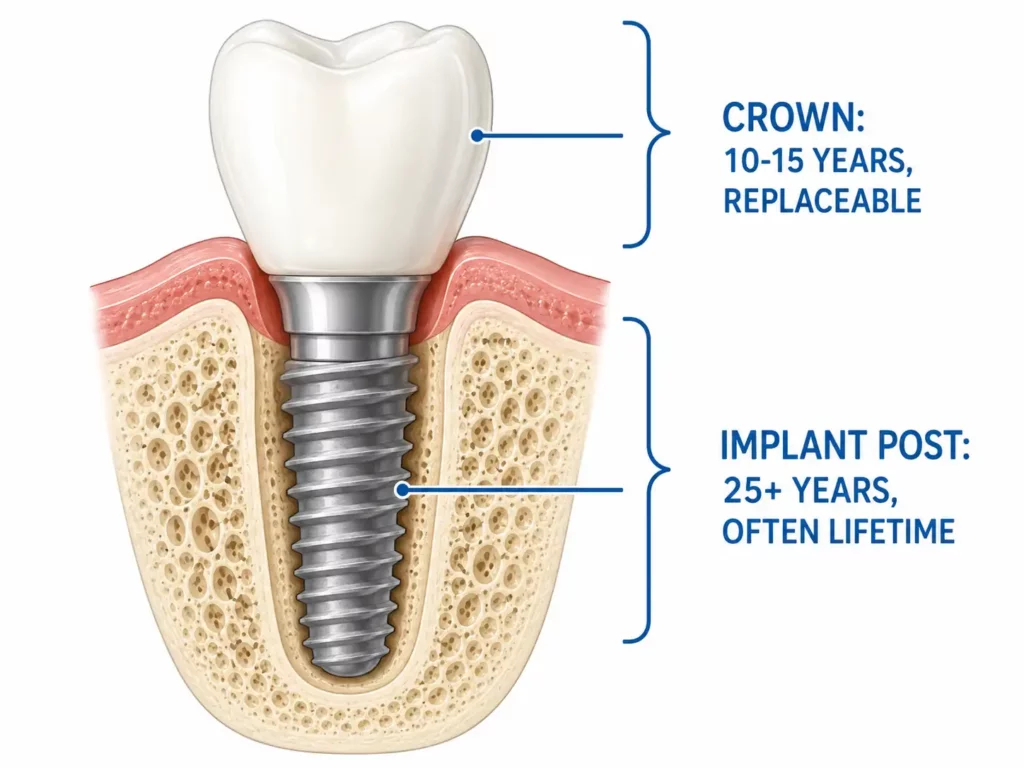
Think of it like a house. The implant post is the foundation. The crown is the roof. Nobody calls a house a failure because it needed new shingles at year 15, and nobody rebuilds the foundation to do the roof.
The reason the post lasts so long comes down to a process called osseointegration. Titanium is biocompatible, which means your jawbone doesn’t treat it as a foreign object. Over the months after placement, bone grows directly against the implant surface and locks it in. At that point the implant isn’t sitting in your jaw. It’s part of your jaw.
The crown lives a harder life. It takes every bite, every grind, every ice cube you shouldn’t be chewing. Ten to fifteen years of that and the porcelain shows it, the same way natural enamel would. When that day comes, the crown is swapped and the post underneath stays right where it is.
If a dentist quotes you one number for “how long implants last,” ask which part they’re talking about. The difference matters when you’re planning decades ahead.
What the 95% Success Rate Actually Means
You’ll see the same statistic everywhere: over 95% of implants are still functioning at ten years. It’s true, and it’s one of the best numbers in all of dentistry.
But let’s talk about the other 5%, because that’s the part that’s actually useful to you.
The failing 5% is not random. The implants we see fail early or wear out fast belong overwhelmingly to a few groups: smokers, patients with untreated gum disease, patients with uncontrolled diabetes, heavy grinders who won’t wear a night guard, and patients who disappear after placement and skip every maintenance visit for years.
Look at that list again. Almost everything on it is a choice or a manageable condition.
That’s the part the statistic hides. Whether your implant lands in the 95% or the 5% is not a coin flip. It’s largely decided by what you do after you leave our chair. That should be genuinely encouraging, because it means the outcome is mostly in your hands.
What Actually Shortens an Implant’s Life, Ranked
Plenty of articles list “factors that affect implant longevity” in no particular order. Here’s the list ranked the way we actually see it in practice, from the biggest threat down.
1. Peri-implantitis (the one that ends implants)
This is gum disease’s cousin, and it attacks the tissue and bone around an implant instead of a natural tooth. It starts quietly, with a little bleeding or puffiness around the implant, and if nobody intervenes it eats the bone that holds your implant in place. Advanced peri-implantitis is the number one reason otherwise healthy implants are lost.
The frustrating part is how preventable it is. Daily cleaning around the implant and regular professional maintenance catch it at the reversible stage. We wrote a full guide on cleaning and maintaining All-On-X implants and the same principles protect single implants.
2. Smoking
Smokers lose implants at roughly twice the rate of non-smokers. Smoking chokes blood flow to the gums, which slows healing after placement and weakens the tissue’s ability to fight off the early stages of peri-implantitis for the life of the implant. If you smoke and you’re considering implants, this is the single highest-value change you can make.
3. Unmanaged grinding
If you clench or grind at night, every implant in your mouth absorbs forces it was never designed for, hour after hour, with none of the shock absorption a natural tooth’s ligament provides. Grinders chew through crowns years early and, in heavy cases, can stress the bone around the post itself. The fix is unglamorous and effective: a properly made night guard. We tell grinding patients that the guard is part of the implant, not an accessory.
4. Skipped maintenance
An implant can’t get a cavity, and that fools people into thinking it doesn’t need the dentist anymore. But the gum and bone around it absolutely do. Patients who keep their regular cleanings and checkups give us the chance to catch problems at the stage where they’re a ten-minute conversation instead of a surgery.
5. Uncontrolled health conditions
Diabetes that isn’t managed, certain medications that affect bone, and conditions that suppress healing all chip away at implant longevity. Notice the word “uncontrolled.” Well-managed diabetics get implants successfully every day. This is about partnership between you, your physician, and your dentist, not disqualification.
Where the Implant Lives Matters Too
Here’s something almost nobody tells patients: not all implant positions age the same.
Molars do the heavy lifting when you chew, so back-of-the-mouth implants and their crowns absorb more force and tend to show wear sooner than front teeth. Front implants have an easier mechanical life but a harder cosmetic job, since the crown has to look perfect in your smile line.
Full-arch systems like All-On-X work differently again. The implants share the load as a team, and the prosthetic arch on top is engineered as a single unit. The posts follow the same decades-long expectations, while the arch itself is a wear component on its own schedule.
None of this changes whether you should get an implant. It changes how we plan, which is why every implant case here starts with a CBCT scan so placement, angle, and bite forces are engineered for the specific spot, not a generic average.
The Age Math Nobody Does For You
“Implants can last a lifetime” means something different depending on when you get one, and we think patients deserve the actual math.
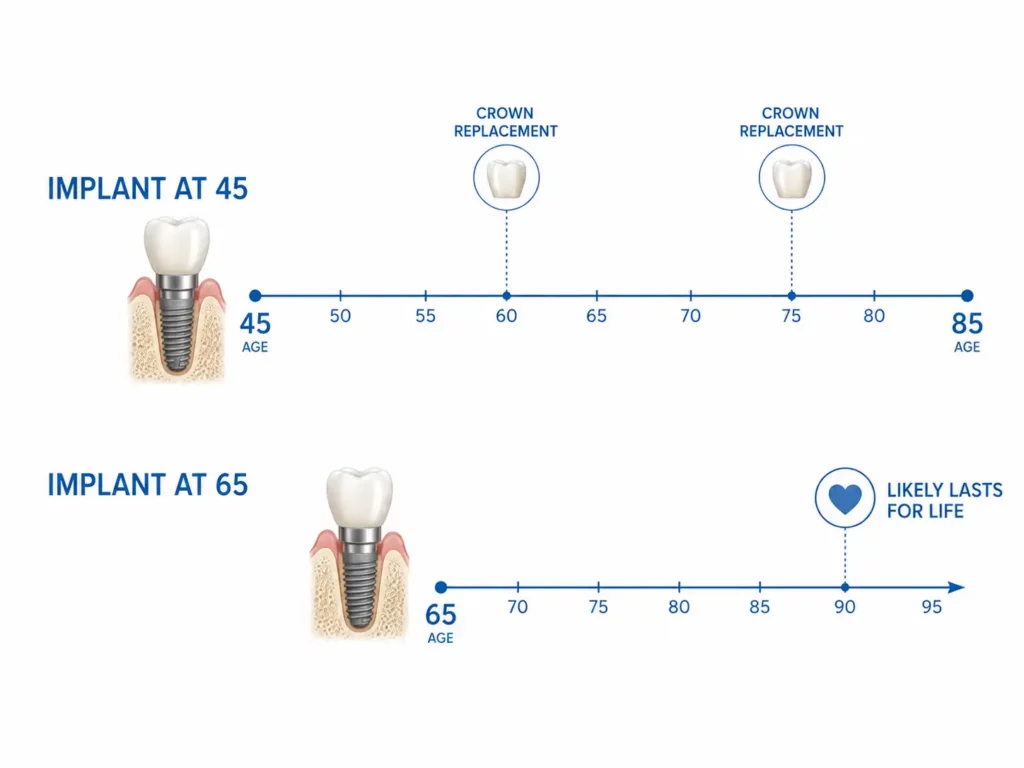
Get an implant at 45, and you’re asking it to perform for 35 or 40 years. Expect one or two crown replacements along the way and hold up your end on maintenance, and the post can genuinely go the distance.
Get an implant at 65, and the actuarial picture flips. That implant, placed well and cared for, will very likely be the last solution that spot ever needs. One investment, done.
This is also the quiet argument against waiting. We regularly meet patients in their 50s who have been living with a missing tooth or a failing bridge for years, waiting for the “right time.” Meanwhile the bone in that area is shrinking, which can turn tomorrow’s straightforward implant into a graft-first project. The best longevity strategy is often simply starting sooner.
How To Make Yours Last 30 Years
The maintenance contract, in plain terms. None of this is exotic:
- Brush twice daily and clean between teeth once a day. Around implants, a water flosser is a genuinely useful addition, not a gimmick.
- Keep professional cleanings on schedule. Twice a year minimum. If you have a history of gum disease, we may recommend more, and here’s why that history matters for implants.
- Wear the night guard if you grind. Non-negotiable. It protects a large investment for the cost of a small one.
- Don’t smoke. Or at minimum, don’t smoke through the healing period, and understand the ongoing risk if you continue.
- Report changes early. Bleeding around the implant, a crown that feels loose, a bite that suddenly feels different. Small symptoms, caught early, are the difference between decades and disappointment.
Early Warning Signs Your Implant Is Asking For Help
An implant that’s heading for trouble almost always whispers before it shouts. Call us if you notice:
- Bleeding or puffiness in the gum around the implant
- The crown feeling loose or rotating slightly
- A change in how your bite comes together
- Tenderness or a dull ache around the implant that wasn’t there before
- Gum visibly pulling away from the implant
Every one of these is dramatically easier to fix in month one than in year two. An implant that gets attention at the whisper stage routinely goes on to a full, uneventful life.
How Implants Compare To the Alternatives
For context, because longevity is a comparison question whether we say so or not. Traditional dentures typically need replacement every 5 to 8 years as the jaw changes shape underneath them. Bridges average 10 to 15 years, and they require grinding down the healthy neighboring teeth that support them, which puts those teeth on their own countdown. We compared these options in depth in our implants versus dentures guide.
An implant is the only option on the list that gets to say “decades, possibly for life.” That’s the honest reason it costs more up front and, spread across the years it serves, frequently costs the least of the three.
Frequently Asked Questions
The titanium post often does, especially with good hygiene, regular maintenance, and no smoking. The crown on top is a wear part with a typical 10 to 15 year lifespan. So “lifetime” honestly describes the post for many patients, while the crown should be expected to need replacement once or twice over the decades.
Every 10 to 15 years on average. Heavy grinders without a night guard wear crowns out faster; careful patients with balanced bites can stretch well past 15 years. Replacing the crown does not disturb the implant post underneath.
Peri-implantitis, an infection of the gum and bone around the implant, is the leading cause of late implant failure. It’s largely preventable with daily cleaning around the implant and regular professional maintenance, which is why home care matters so much to longevity.
Yes, significantly. Smokers experience implant failure at roughly twice the rate of non-smokers because smoking restricts blood flow to the gums, impairing healing and the tissue’s long-term ability to resist infection around the implant.
Usually, yes. The failed implant is removed, the site is allowed to heal, sometimes with bone grafting, and a new implant can often be placed. Catching problems early makes every version of this easier, which is why we take symptoms around an implant seriously.
The crowns often do, because molars absorb far more chewing force than front teeth. The implant posts themselves hold up well in both positions when properly placed and planned, which is why we engineer placement with 3D CBCT imaging.
Brush twice daily, clean between teeth daily (a water flosser helps around implants), keep professional cleanings at least twice a year, wear a night guard if you grind, don’t smoke, and report any bleeding, looseness, or bite changes early.
For most candidates, yes, and longevity is the reason. Dentures typically need replacing every 5 to 8 years and bridges every 10 to 15, while an implant post can serve for decades. Spread across the years of service, implants are frequently the most economical option of the three.
The Last Tooth Decision You Make For That Spot
Here’s how we frame it for patients weighing the decision. Done right, and maintained, a dental implant is designed to be the last decision you ever make about that spot in your mouth. Not a five-year patch. Not a countdown. A solution.
Whether yours lasts 15 years or 40 depends on planning, placement, and the partnership afterward, and all three of those are things we can control together. If you’re weighing an implant, or you have one and want to make sure it goes the distance, come talk to us. We’ll take a 3D scan, look at your specific situation, and give you the honest version, the same one you just read.
Call us at (586) 731-9240 or reach out through the contact page to schedule your consultation.
Contact Us to Schedule Free Consultation Today!