
What should you do in a dental emergency? Call a dentist immediately, then act on what you see: put a knocked-out adult tooth back in its socket or keep it moist in milk, hold firm pressure on bleeding, use a cold compress for swelling. Go to the emergency room instead for trouble breathing or swallowing, spreading facial swelling, or a head injury.
Christopher J. Manduzzi, DDS, PC treats dental emergencies for patients across Utica, Shelby Township, Sterling Heights, Rochester Hills, and the greater Macomb County area of Michigan.
Almost nobody reads this page on a calm afternoon. You are reading it because something just happened, it is probably after hours, and the question underneath every other question is the same one: does this need attention right now, or can it wait until an office opens?
So we will answer that first, with actual thresholds instead of “call your dentist.” Then we will walk the three injuries that fill emergency slots in our office more than any others, and be honest about the ones where a dental chair is the wrong destination entirely.
Is This a Dental Emergency Tonight, or Can It Wait Until Monday?
Short answer: Airway, spreading infection, uncontrolled bleeding, and head trauma belong at a hospital. A knocked-out permanent tooth needs immediate dental care; severe tooth pain, localized swelling, or a displaced tooth generally needs urgent same-day evaluation. A lost crown or a small chip with no pain belongs at the next available appointment.
Most general “dental emergency” articles hand you a list of injuries and then tell you to phone somebody. That is not a threshold. Here is the one we use when the phone rings at night.
| What you are seeing | Where to go | How fast |
|---|---|---|
| Trouble breathing or swallowing, swelling tracking toward the eye or down under the jaw and neck, fever with feeling genuinely unwell, significant difficulty opening the mouth associated with a spreading dental infection, loss of consciousness | Call 911 or go to a hospital emergency department | Immediately |
| Facial trauma with a head injury, a jaw that will not close normally, or bleeding that has not slowed after about 15 minutes of firm pressure | Hospital emergency department | Immediately |
| An adult tooth knocked completely out of the socket | Dental office, calling on the way | Immediately. Replant at the scene if you can; minutes change the prognosis. |
| Localized swelling or a gum boil with normal breathing and no fever, reduced mouth opening without signs of spreading infection, severe toothache that will not settle, a tooth loosened or shoved out of line, a large fracture exposing a pink or red center | Same-day dental appointment | Today |
| A crown or filling that came off with no pain, a small chip with a rough edge, sensitivity that fades within a minute | Dental office, regular appointment | Days, not weeks |
The bottom row is where people get burned, in the opposite direction from what you would expect. Not because it is dangerous tonight, but because “no pain” gets read as “no problem,” and the appointment never gets made. We will come back to that when we talk about crowns.
Two practical notes on access, because they change the math. Our doors in downtown Utica open at 7:00 AM Tuesday through Thursday and we are open Saturday from 8:00 AM to 3:00 PM. For a lot of what happens on a Friday night or before a work shift, the real question is not “emergency room or dentist,” it is “can I get through the night safely and be seen first thing.” Often the answer is yes. Call as early as you can and we will fit urgent cases in wherever the schedule allows.
What Should You Do in the First Hour After a Tooth Is Knocked Out?
Short answer: For a permanent tooth, handle it by the crown only, put it straight back in the socket if you can, and get to a dentist right away. If replanting is not possible, keep it moist in milk or a tooth preservation solution. Never scrub the root, and never replant a baby tooth.
The tissue that decides whether this tooth survives is a thin layer of ligament cells clinging to the root surface. They are living cells, they dry out fast, and almost every mistake people make in the first ten minutes involves damaging them: wiping the root on a shirt, scrubbing it under the faucet, or dropping it in a glass of tap water for the ride.
- Pick it up by the crown. The chewing surface, never the pointed root end. Fingers on the root are fingers on the tissue you are trying to save.
- Do not scrub, dry, or disinfect it. Current IADT first aid guidance is to rinse a visibly dirty root gently with milk, saline, or the person’s own saliva, and to use water only if none of those is at hand. A brief rinse and nothing more. No soap, no alcohol, no towel, no scrubbing.
- Put it back in the socket if you reasonably can. Line it up the way it sat, press it gently into place, and have the person bite softly on a clean cloth or gauze to hold it. This is the single best outcome for the tooth, and a parent or bystander doing it at the scene beats waiting for a professional.
- If it will not go back, keep it wet. See the options below. Dry time is the enemy.
- Control bleeding and call while you travel. Firm pressure with gauze on the socket, and a phone call so the office knows what is walking through the door.
Where Should You Put the Tooth If You Cannot Replant It?
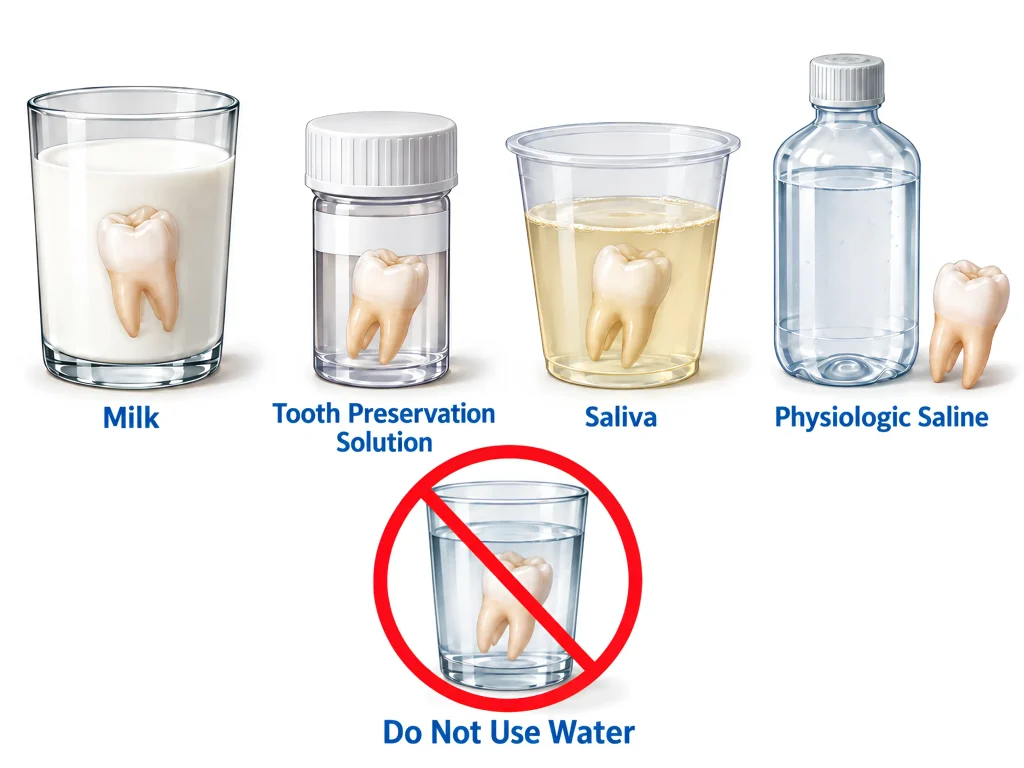
One thing to be clear about before the list. Everything below is what you reach for when putting the tooth back in its socket is genuinely not possible. These are alternatives to replanting, not steps that come after it. Any of them is an appropriate way to keep the tooth moist, so use whichever one you can actually get your hands on quickly rather than hunting for a better one.
- Milk. Suitable for transporting an avulsed tooth, and the one appropriate liquid actually sitting in most refrigerators.
- A tooth preservation solution containing a balanced salt solution (HBSS). Made for exactly this; some schools, athletic trainers, and first aid kits keep one.
- The patient’s own saliva, spat into a clean cup with the tooth in it. Do not hold the tooth in the cheek; a tooth in the mouth can be swallowed or inhaled, and that risk is highest in exactly the situations trauma creates.
- Physiologic saline, the plain sterile saline sold for wound irrigation. Check the label reads sterile saline only; contact lens solutions are frequently disinfecting solutions, which are not the same thing.
Plain tap water is the common instinct and the last resort. It is hard on the ligament cells the whole exercise is meant to protect. But guidance is explicit that water still beats letting the tooth dry out, so if water is genuinely all you have, use it and move fast.
Contact Us To Schedule An Appointment!What If an Hour Has Already Passed?
Then you are the majority of people who will read this section, and every article that stops at “see a dentist within 30 minutes” has just abandoned you. Here is the honest version.
Once a tooth has been dry for roughly an hour, the ligament cells are generally not considered viable, and the odds of the tooth reattaching normally drop sharply. That is a real change in prognosis. It is not the same as a closed door. Replanting is still frequently attempted well past that window, and the decision belongs to a dentist looking at the tooth, the socket, and the patient’s age, not to a stopwatch.
Two things worth knowing going in. A replanted tooth commonly needs root canal treatment afterward, and a replanted tooth is a repair with a lifespan rather than a restoration to original condition. Some last decades. Some do not. Bring the tooth anyway, kept moist, even if it looks hopeless to you.
What About a Knocked-Out Baby Tooth?
Do not put it back. A primary tooth pushed back into the socket can damage the permanent tooth developing underneath it, and pediatric dental guidance is consistent on this point. Control the bleeding, keep your child comfortable, and call us. The visit still matters because the socket, neighboring teeth, and developing permanent teeth should be evaluated for associated injury, which is what a children’s dentistry appointment after a fall is for.
How Do You Tell a Harmless Chip From a Cracked Tooth?
“Cracked tooth” gets used for five genuinely different problems, which is why the internet’s advice on it feels so useless. The symptom that separates them is not how it looks in the mirror. It is what the tooth does when you bite.
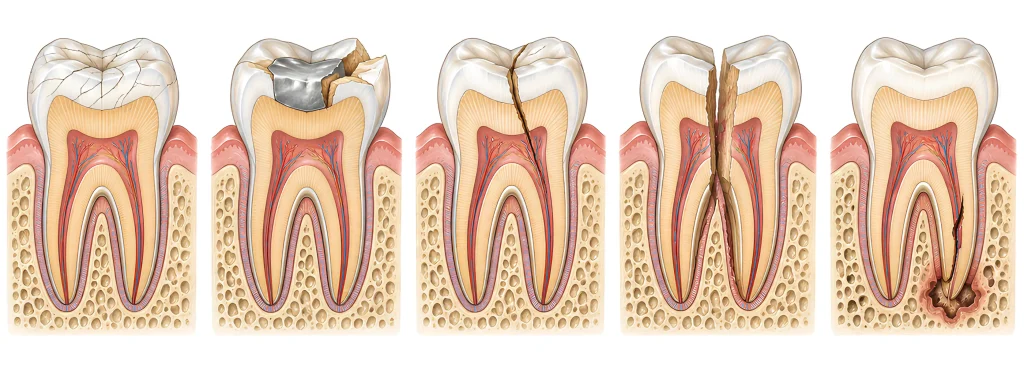
- Craze lines. Hairline surface marks in the enamel, no pain, extremely common in adults. Cosmetic at most.
- Fractured cusp. A corner of the tooth breaks away, often around an old large filling. Sharp edge, sometimes temperature sensitivity, frequently not much pain, because the break tends to spare the nerve.
- Cracked tooth. The classic tell is pain on release of biting pressure rather than on the bite itself. A zing when you let go of a hard piece of food. That specific pattern is worth reporting on the phone, because it points somewhere.
- Split tooth. A crack that has finished traveling and separated the tooth into segments. Often painful and often not fully savable, though sometimes a segment can be kept.
- Vertical root fracture. Starts at the root and works upward. It can stay quiet for a long time and show up as gum swelling or a small boil rather than tooth pain, which is exactly why it gets found late.
Until you are seen:
soft foods, chew on the other side, skip very hot and very cold, and cover a sharp edge with dental wax or a piece of sugar-free gum so it stops shredding your tongue. Warm salt water rinses are fine. Aspirin held against the gum is not; it burns tissue. The American Association of Endodontists keeps a plain-language rundown of these fracture types if you want to compare notes before your visit.
What Should You Do When a Crown Comes Off?
Short answer: Keep the crown, keep it clean, stop chewing on that side, and book an appointment within days. Do not force it back on, and never use household glue. A permanent crown that comes off is a reason to look at the tooth underneath it, not just the crown.
Almost every page that ranks for a lost crown is quietly written about a temporary crown, the plastic placeholder worn for a couple of weeks between appointments. Those are cemented to pop off. The advice about dabbing on toothpaste or denture adhesive to keep it seated came from that situation, and then got copied onto pages about permanent crowns, where it does not belong.
Here is the difference that matters. A permanent crown is cemented to stay. When one comes off years later, that is a reason to look at the tooth underneath it, not just the crown. Common findings include decay at the margin where the crown meets the tooth, cement that has broken down, or a fracture in the remaining tooth structure. The crown itself is often perfectly fine. That is the insight the SERP is missing, and it has a practical consequence. Sealing the crown back down at the kitchen table with drugstore cement can make the symptom disappear while leaving the actual reason it let go undiagnosed.
So: rinse the crown, put it somewhere you will not lose it (not a napkin), keep the exposed tooth clean, and call. If the exposed tooth is sharply sensitive and you cannot be seen for a day or two, over-the-counter temporary cement is a reasonable comfort measure, used gently and never forced. Superglue is never the answer, at any hour, for any reason. It is not made for the mouth, and it can make saving the tooth harder for whoever removes it.
If the crown went down the sink or into a bowl of cereal and is genuinely gone, that is not a catastrophe. Bring the tooth. Replacement is routine, and our crown and bridge work starts from the same examination either way. Same story for a filling that fell out, which usually ends in a new composite filling once we see how much tooth is left.
Swollen Face: Emergency Room or Dental Office?
This is the question people get wrong in both directions, and it is the one where getting it wrong actually matters.
Go to a hospital emergency department, or call 911, if there is any difficulty breathing or swallowing, if the swelling is spreading toward the eye or down under the jaw into the neck, if you have a fever and feel systemically unwell, if significant difficulty opening your mouth comes along with that spreading swelling, or if there is any loss of consciousness. Those findings are about airway and spread, not about teeth, and a dental office is not the right room for them.
Localized swelling around one tooth, with normal breathing and swallowing and no fever, is an urgent dental visit rather than an ER trip. Worth knowing before you sit in a waiting room for six hours: emergency departments can manage pain, evaluate serious infection or trauma, and prescribe antibiotics when clinically indicated, but they typically cannot provide definitive treatment of the tooth itself. That part waits for a dentist regardless, which is why a same-day dental appointment often gets you further, faster, when the danger signs above are absent.
Will the Tooth Need a Root Canal, a Crown, or an Extraction?
The general rule is easy to state and hard to apply. A crack that has reached the pulp but stays above the gumline tends toward root canal treatment followed by a crown to hold the tooth together. A crack that runs below the gumline, or a vertical root fracture, tends toward extraction. Every article says this much.
What none of them say is why you so often leave a first visit without an answer. Root fractures are notoriously difficult to see on a conventional two-dimensional X-ray, because a crack aligned the wrong way relative to the beam can simply not show up. That is the real reason a dentist says “we will know more later.” It is not hedging. It is the limit of the image.
We keep a 3D CBCT scanner in the office, alongside digital X-rays. A CBCT scan may reveal fracture lines or associated patterns of bone loss that a two-dimensional radiograph misses and can provide additional information during the diagnostic process. It is not a crystal ball, and some fractures are still only confirmed once the tooth is opened or removed.
If the answer turns out to be extraction, one more thing works in your favor here. Christopher J. Manduzzi, DDS is a general dentist who performs the surgical side himself, from oral surgery and extractions through dental implant placement, including mini implants and All-On-X full arch cases. He is a Fellow of the ICOI, a member of the IAMDI, and has been named an Hour Detroit Top Dentist seven times. For an emergency patient, the practical translation is simple: the diagnosis, the extraction, and the replacement plan can live with one office instead of stretching across three appointments in three buildings.
On cost, we will not quote a number on a web page, because the honest ones depend on what the scan shows. What we will do is go through the factors and your insurance coverage with you before anything gets started.
What Should You Say When You Call, and What Should You Bring?
Lead with four facts and the person answering can triage you in about twenty seconds instead of two minutes.
- What happened. Fall, sports hit, bit down on something, or it just started hurting on its own.
- When it happened. The clock matters enormously for a knocked-out tooth and barely at all for a lost crown, and we cannot tell which situation you are in until you say.
- Whether there is swelling or fever. This is the fact that decides whether we are booking you or sending you to a hospital.
- Whether you have the tooth, the crown, or the fragment in hand. If yes, we will tell you how to transport it before you hang up.
Bring the piece even when it looks like garbage. A fragment can tell us how the tooth failed, and occasionally a clean broken piece of a front tooth can be bonded back. Bring your insurance card, a photo ID, and a list of your current medications, blood thinners especially.
When Are We the Wrong Door?
We would rather tell you this here than after you have driven in. Airway symptoms, spreading infection, suspected facial or jaw fractures, and head injuries are hospital problems, not dental office problems. A tooth that has been split to the root or lost most of its bone support is often not savable no matter how quickly you get here, and we will say that plainly rather than sell you a heroic attempt.
And there are cases we hand off on purpose. Zygomatic implant cases, for one, go to a specialist, because the right answer to “can you do this” is sometimes “yes, but someone else should.”
How Do Most of These Actually Happen?
Not dramatically, mostly. Popcorn kernels and ice. Old, large fillings in molars that have been quietly flexing for fifteen years. A cracked tooth someone has been chewing around for months because it only twinges sometimes. And youth sports, which is the category where the risk is most reducible. A properly fitted mouthguard meaningfully lowers the chance of a dental injury, and we make custom sports mouthguards for exactly that reason.
Waiting does not always make things worse, and we are not going to pretend it follows a schedule. But a crack a crown could have held can progress to needing root canal treatment or extraction, and a localized infection can spread. Those are possibilities worth respecting, not prophecies.
Frequently Asked Questions
Sooner is dramatically better, and replanting it in the socket immediately gives the tooth its best chance. After roughly an hour of dry time, the ligament cells on the root are generally no longer viable and the outlook worsens considerably. Replantation is still often attempted after that. Bring the tooth in regardless, kept moist.
Trauma guidance advises against plain tap water, because it is harsh on the living ligament cells covering the root surface. Milk is an appropriate option and is usually within reach, as is a tooth preservation solution if one is available. Guidance is explicit that water still beats letting the tooth dry out, so if water is genuinely all you have, use it and move fast.
For pain alone, usually not. Emergency departments can manage pain and prescribe antibiotics when clinically indicated, but they typically cannot provide definitive treatment of the tooth causing the problem. Go to the ER for difficulty breathing or swallowing, swelling spreading toward the eye or neck, fever with feeling very unwell, loss of consciousness, or trauma involving a head injury.
Never with household or superglue. It is not intended for the mouth and can complicate treatment later. Over-the-counter temporary dental cement is acceptable as a short-term comfort measure if the tooth is sensitive, applied gently and never forced. Either way, get seen promptly, because the reason it came off still needs finding.
No, and that is part of why cracks get missed. Craze lines cause nothing at all, and a fractured cusp is often just a sharp edge. The classic sign of a true crack is a sharp pain when you release biting pressure rather than when you bite down. Vertical root fractures can present as gum swelling instead.
Do not attempt to put it back. Replanting a primary tooth can damage the permanent tooth forming underneath. Control bleeding with gentle gauze pressure, use a cold compress for swelling, comfort your child, and call us so we can check the socket and the surrounding teeth for other injuries.
That is our aim. We will fit urgent cases in wherever the schedule allows, and our hours help: we open at 7:00 AM Tuesday through Thursday and see patients Saturday from 8:00 AM to 3:00 PM. Call as early as you can so we know what is coming and can prepare for it.
Get Seen in Downtown Utica
Christopher J. Manduzzi, DDS, PC has practiced on Summers St in historic downtown Utica since 2013, with a 4.9-star rating across more than 483 patient reviews. If something happened tonight, call us at (586) 731-9240 or reach out through the contact page, and read more about how we handle urgent dental problems before you arrive.
Contact Us To Schedule An Appointment!