
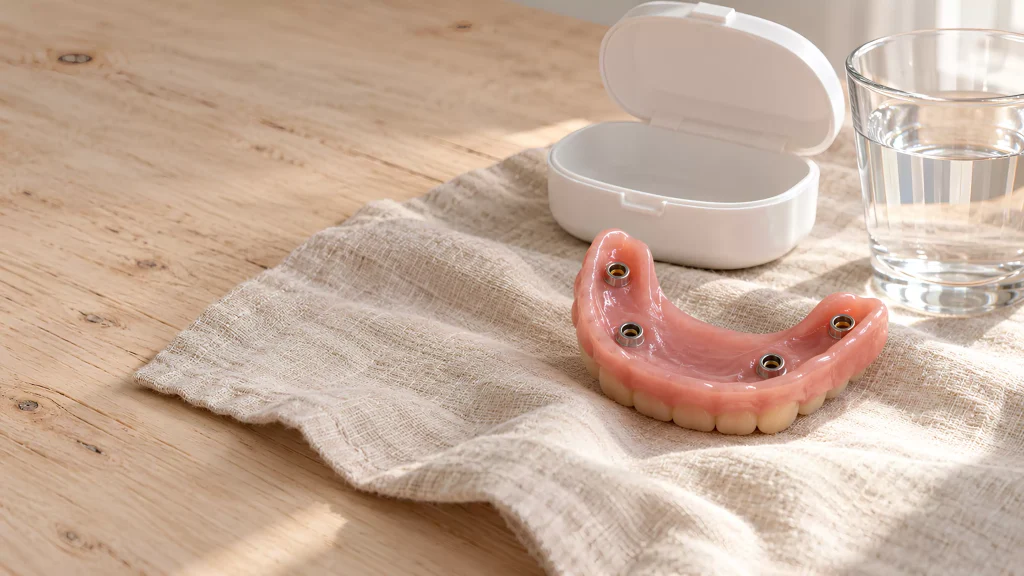
Are mini dental implants a good fix for a loose lower denture? Often, yes. Mini dental implants are narrow, one-piece posts, commonly four placed in the front of the lower jaw, that let a loose lower denture snap into place. They suit a ridge that is narrow but tall enough and a patient who doesn’t clench heavily. A 3D CBCT scan of the ridge, along with your health history and bite, determines candidacy.
Christopher J. Manduzzi, DDS, PC serves patients across Utica, Shelby Township, Sterling Heights, Rochester Hills and the greater Macomb County area, Michigan.
A lower denture has a harder job than an upper one. The upper covers the palate and can hold by suction. The lower sits on a narrow horseshoe of gum, with the tongue and cheeks pushing on it every time you talk or chew, and the bone underneath tends to shrink over the years.
Mini implants give that denture something to grip. Whether they’re the right anchor for your mouth depends on two things: the denture you already have and the shape of the bone under it.
What Are Mini Dental Implants, and Why Do They Suit the Lower Jaw?
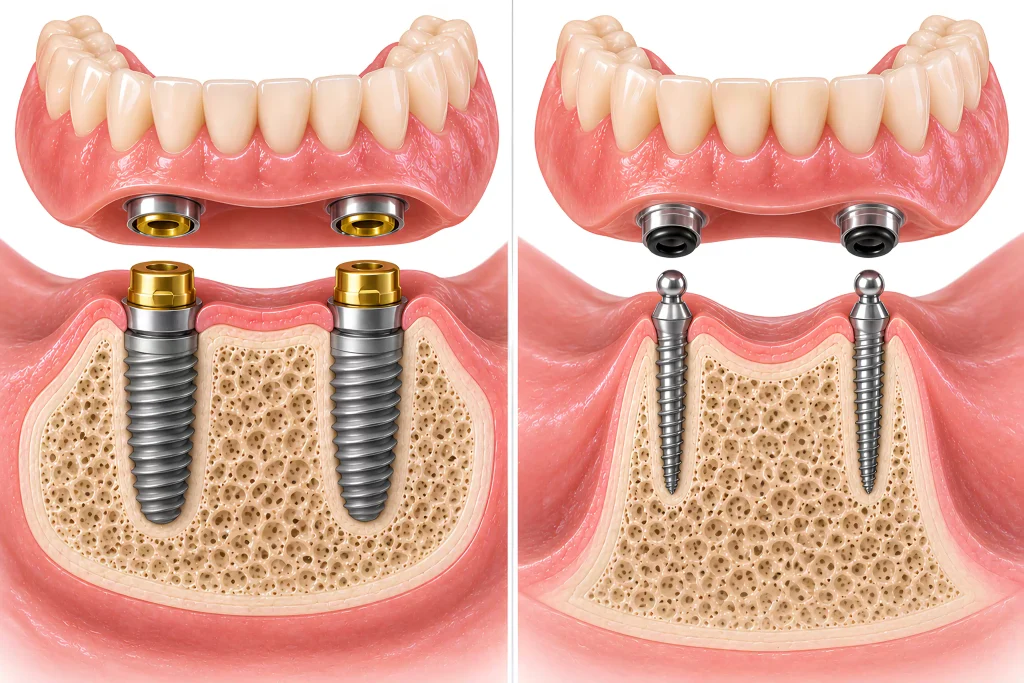
Mini dental implants are narrow titanium posts, generally under 3 millimeters wide, made as a single piece with a ball-shaped head that sits just above the gum. Standard dental implants are wider, generally about 3.5 millimeters and up, and most come in two parts: a post in the bone and a separate connector on top.
Small housings fitted inside the denture, each holding a rubber O-ring or nylon cap, snap over the ball heads. The denture still comes out for cleaning. It just stops drifting when you eat.
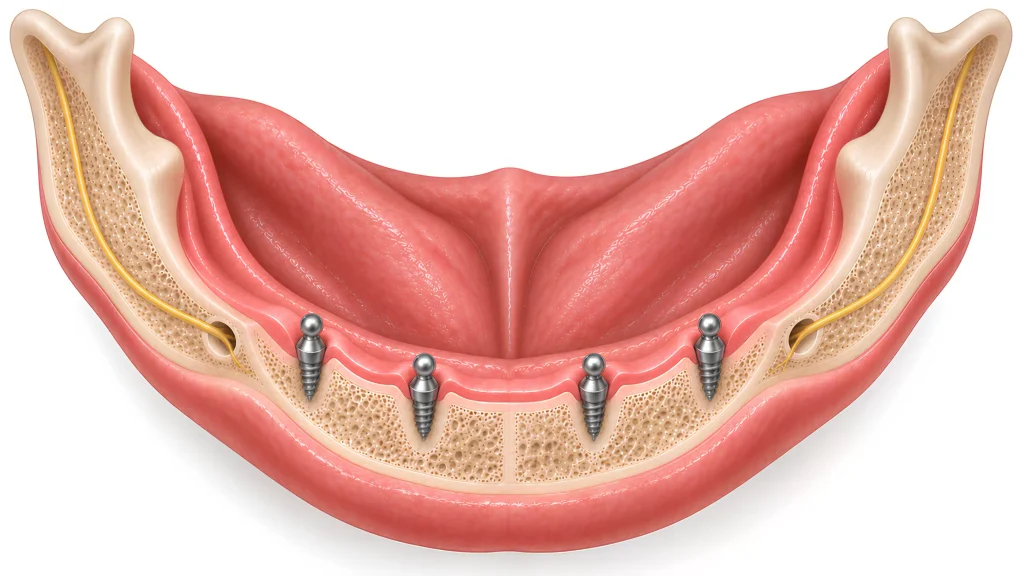
The front of the lower jaw is where minis fit best. Between the two openings where the chin nerves exit the bone, usually below the premolars on each side, the bone is often dense and away from the main nerve that runs through the back of the jaw. That stretch can be narrow from cheek to tongue and still hold minis.
Four Minis or Two Standard Implants?
The long-established plan for a lower denture uses two standard implants. A 2002 consensus statement from McGill University recommended that the two-implant overdenture be considered the first-choice standard of care for a toothless lower jaw, and much of the long-term research follows that design.
Mini protocols commonly use four, spread across the front of the jaw, to make up for each implant’s smaller size. Your scan helps determine the actual number and position. Upper dentures are a separate question: the upper bone is usually softer and generally needs more implants, so it gets its own evaluation.
Contact Us to Schedule Free Consultation Today!Can Mini Implants Hold the Lower Denture You Already Have?
Short answer: Sometimes. Your current denture can be fitted with attachments if it still fits your ridge, your bite on it is still correct, and the acrylic is thick enough to hold the housings. If it misses on any of the three, it may need a reline, repair or replacement first.
Fitting attachments into an existing denture is called a retrofit. We place the minis, then set the housings into hollows cut into the underside of the denture you already wear. When it works, it’s the faster path, so it’s the first thing we check.
- It fits the ridge. A denture that rocks because the gums have shrunk beneath it needs a reline or replacement first, since a poor fit can put uneven force on the implants.
- The bite is still right. If the teeth have worn flat or the bite has shifted, holding the denture down more firmly won’t make it chew better.
- There’s enough acrylic. Each housing needs room in the denture base. A thin base, or one that has been cracked and repaired, can weaken or break around the hollows.
The denture’s age matters less than those three checks. An older denture that still fits well can be a good candidate, and a newer one that never fit won’t be improved by adding implants.
When a new lower denture is needed, it adds appointments for impressions, a try-in and delivery. It takes longer, and the denture is designed around the implants from the start.
Learn more about our complete and partial dentures
How Thin Can Your Ridge Be for Mini Implants?
Short answer: There’s no single cutoff. Width is what lets a mini fit where a standard implant won’t, but the ridge also needs enough height and span, and only a 3D scan measures all three.
Your ridge is the arch of bone that once held your lower teeth. When we evaluate it for implants, we look at three measurements:
- Width, from the cheek side to the tongue side. This is where minis earn their place. Standard implants under a lower denture generally call for a ridge of about 5 to 6 millimeters wide or more, and a ridge narrower than that may still take minis.
- Height, from the top of the ridge down through the jaw. A mini still needs length to hold, and studies of minis under lower dentures generally use implants around 10 millimeters long or longer. A ridge that is thin but tall is a very different case from one that is thin and short.
- Span, the curve of bone between the two nerve openings. Four minis need room to spread out, with space between each one.
Why a Flat X-Ray Can’t Answer the Question
A panoramic X-ray, the wide flat image of the whole jaw, shows ridge height reasonably well. It can’t show width, because the image flattens the jaw and the cheek-to-tongue dimension disappears into it. A ridge that looks healthy on a panoramic can turn out to be knife-edge thin in cross-section.
That’s why every implant case at our office starts with an in-house CBCT scan, a cone-beam 3D image that shows the ridge slice by slice at each spot where an implant would go. Flat digital X-rays still have their uses for checking teeth and gums, but implant planning needs the third dimension.
So the practical answer to how thin is too thin: whatever the scan shows at the exact implant sites, measured in all three directions.
Does Waiting Narrow Your Options?
It can. Bone that no longer holds teeth tends to shrink, and a denture resting on it doesn’t stop that. The pace varies a great deal between people, so there’s no deadline to quote.
A ridge that is borderline for standard implants now may later suit only minis, or need grafting first. If your lower denture has been getting looser, a scan tells you where your ridge stands today.
How Do Minis Compare With Standard Implants for Lifespan and Repair?
Short answer: Minis holding a lower denture show good long-term results in the studies available, but the evidence behind them is thinner than for standard implants. The bigger day-to-day difference is repair: a damaged mini is usually replaced, while a standard implant’s top piece can be swapped.
What the Long-Term Research Shows
One of the longest studies of one-piece minis under lower dentures followed 14 patients for 10 years: all 56 implants were still in place, with an average of about 1 millimeter of bone loss around them. That’s an encouraging result, but it comes from a small group in a single study.
Reviews of the mini-implant research rate the certainty of evidence as low to moderate. Recent reviews of the trials find minis perform comparably to standard implants under lower dentures, but follow-up is shorter and the studies are smaller. A 2018 meta-analysis found lower survival for implants under 3 millimeters wide than for standard-width implants, though slightly wider narrow implants showed no difference. Two standard implants under a lower denture have a deeper body of research behind them.
Put together, minis are a reasonable option for a narrow lower ridge with encouraging long-term data, but they have not been shown to last as long as standard implants. When the ridge can take standard implants without grafting, that difference belongs in the decision.
What Wears Out and What Gets Replaced
The O-rings or caps inside the denture are wear parts. They lose grip gradually and get swapped at maintenance visits, usually a quick chairside change. The denture itself will still need relines over time as the gums change.
The implant is where the two designs differ. A standard implant has a separate connector screwed onto it, so a worn connector can be replaced while the implant stays in the bone.
A one-piece mini has no separate part. If its head wears or bends, or the implant loosens, the usual fix is removing that mini and placing a new one, sometimes in a nearby spot.
Daily cleaning around each head keeps the gum healthy, and regular professional cleanings give us a chance to check the heads, the O-rings and the denture fit at the same visit.
Is It One Visit, and How Sore Will You Be Afterward?
Short answer: It can be one visit when your current denture can be retrofitted and the minis are firm in the bone right away. A new denture, or bone that needs time to heal first, makes it staged.
Two things decide which path you’re on:
- The denture. A retrofit can happen at the same appointment as placement, while a new denture is made over several visits with the attachments built in.
- Stability at placement. Each mini needs to be held firmly by the bone the moment it goes in. If it is, the housings can be connected to the denture that day; if the bone is softer than expected, we may reline the denture with a soft material and let the bone heal before connecting it.
Minis are usually placed with local anesthetic through small openings in the gum, often without stitches.
What Soreness Should You Expect?
Soreness after placement usually comes from two places: the implant sites themselves, and the denture settling onto its new attachments. The implant sites generally ease as the gum heals. The denture can cause sore spots where it now presses differently.
A follow-up adjustment visit to relieve those spots is a routine part of the process. Here’s how to sort what you’re feeling:
- Call us during office hours for denture sore spots, a cap that feels loose, or trouble seating the denture.
- Get seen the same day for pain that is getting worse instead of easing, swelling that keeps growing, or an implant that moves. Call right away so we can arrange an urgent dental visit.
- Go to the emergency room or call 911 for swelling that affects breathing or swallowing, or facial swelling with a high fever.
When Would We Recommend Standard Implants or Something Else Instead?
Short answer: When the ridge is too short, when you clench or grind heavily, or when you want teeth that don’t come out. Each of those points to a different option, and a ridge too shrunken for any standard approach needs a further surgical evaluation.
Minis solve one specific problem well: a narrow ridge under a denture that’s otherwise in good shape. These are the situations where we’d point you elsewhere, and what we’d point you toward:
- Not enough height. A narrow ridge suits minis; a short one usually doesn’t. Standard implants, sometimes after bone grafting, are the more likely answer, and standard implant placement starts with the same 3D scan.
- Heavy clenching or grinding. Narrow implants are generally considered less suited to heavy biting forces, so clenching and grinding call for individual planning before choosing between minis and standard implants.
- You want teeth that stay in. Minis hold a removable denture. Fixed teeth on implants are a different treatment, such as All-On-X full-arch implants.
- A ridge too resorbed for either. We’ll tell you so and explain the grafting and other options, including whether a specialist referral makes sense.
- Medical factors. Uncontrolled diabetes, smoking, past radiation to the head and neck, and some bone-strengthening medications used for osteoporosis can raise the risk of healing problems with any implant. They don’t automatically rule implants out, but they call for a closer look and sometimes a word with your physician.
If failing upper teeth or other dental problems are part of the picture, the lower denture may be one piece of a larger plan, and full mouth rehabilitation looks at the whole mouth together.
Frequently Asked Questions
Four is common for a lower denture, placed across the front of the jaw between the points where the chin nerves exit the bone. Some mouths take more or fewer depending on the ridge. The number is set from your 3D CBCT scan, along with the length and position of each implant, before anything is placed.
They are placed to stay, and long-term studies of minis under lower dentures show good results, though the research is thinner than for standard implants. The parts that wear are the O-rings or caps inside the denture, which get replaced at maintenance visits. A damaged mini is usually removed and replaced, since it has no separate top piece.
Yes. Minis hold a removable overdenture, so it snaps in and comes out for cleaning. You’ll clean the denture and brush gently around each implant head every day, and we’ll go over overnight wear and cleaning when the denture is connected. If you want teeth that never come out, that’s a fixed full-arch option instead.
Placement is done with local anesthetic, usually through small openings in the gum. Afterward, expect soreness at the implant sites and some sore spots as the denture settles onto the attachments. A follow-up adjustment is normal. Pain that is getting worse rather than better, or swelling that keeps growing, should be checked the same day.
Sometimes, but the upper jaw is a different case. The bone there is usually softer than in the front of the lower jaw, and upper protocols generally call for more implants. The upper denture also holds by suction against the palate, so the reasons it loosens differ. An upper evaluation starts with the same 3D scan.
Age on its own is rarely the deciding factor. What matters is your bone, your general health, any medications that affect healing, and whether you can keep the implant heads clean each day. Implant-retained lower dentures are commonly placed for older adults. A health history review and a CBCT scan answer the question for you specifically.
The main factors are how many implants you need, whether your current denture can be retrofitted or a new one is required, and the imaging involved. We go over those at your consultation. We accept many plans, including Delta Dental, Blue Cross/Blue Shield and MetLife, and we review your coverage up front so you know where you stand.
Mini Dental Implants in Historic Downtown Utica
Christopher J. Manduzzi, DDS, a Fellow of the International Congress of Oral Implantologists and a member of the International Academy of Mini Dental Implants, places mini implants himself. The CBCT scan, the plan and the placement all happen in our office, a historic home on Summers St in downtown Utica where Dr. Manduzzi has practiced since 2013.
Call us at (586) 731-9240 or reach out through the contact page to schedule a mini implant consultation. Wear your current lower denture to the visit, and bring your insurance card and a photo ID.
Contact Us to Schedule Free Consultation Today!